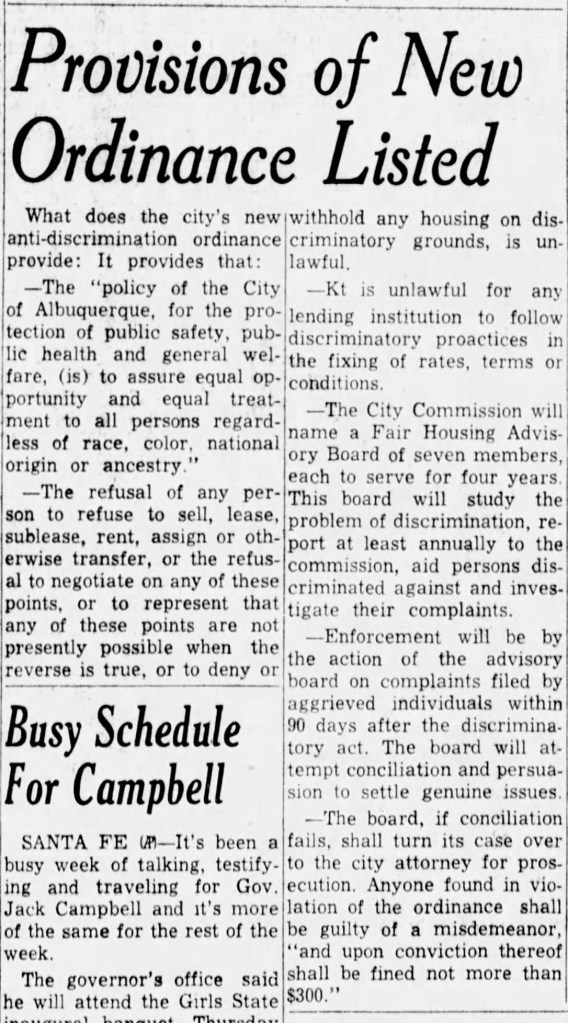
Albuquerque’s City Commission passed legislation on August 18, 1963 outlawing housing discrimination as outlined thus by the Journal the next morning:
As emergency legislation, it went into effect only eight days after unamimous Commission passage. The story was front page news:
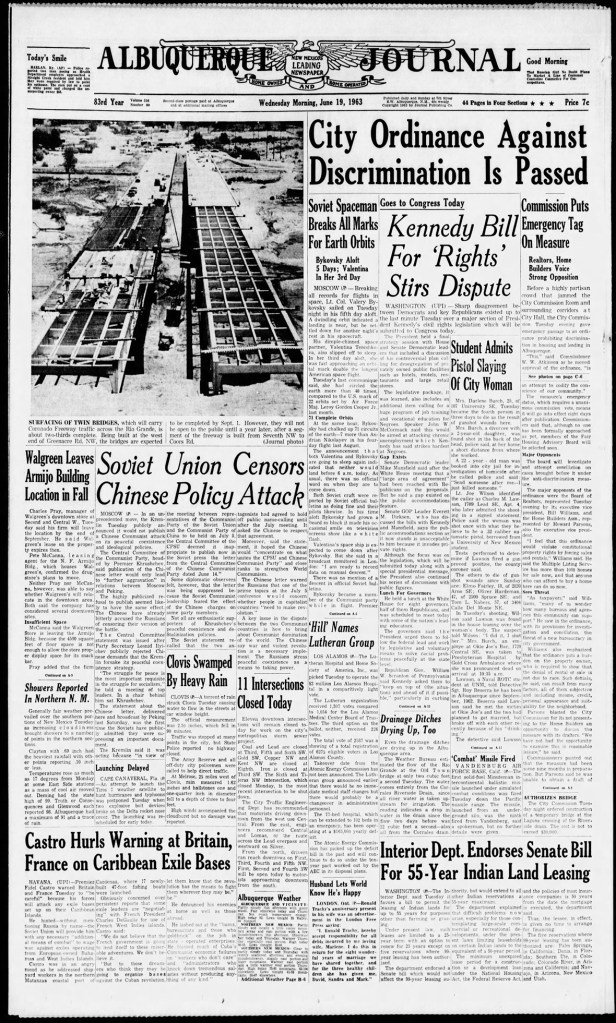
Just as ABQ had done with passage of anti-discrimination legislation for public accommodations in 1952, the City was again years ahead of the federal government, which only got around to passing a similar Fair Housing Act in 1968.
Yay Albuquerque and Yay never having housing discrimination within our city limits again. Right?
Right?
Uh, not exactly. As noted in our last post, the City’s “Fair Housing Advisory Board” was still reviewing cases of discrimination in 1967. And it doesn’t stop there and perhaps hasn’t stopped even today. For instance, here’s a January 1971 story (almost eight full years since passage) about a new committee formed to address housing discrimination in meeting with the Advisory Board. Interestingly, the committee was composed of three “Negro appointees” and three “Spanish-American appointees.”
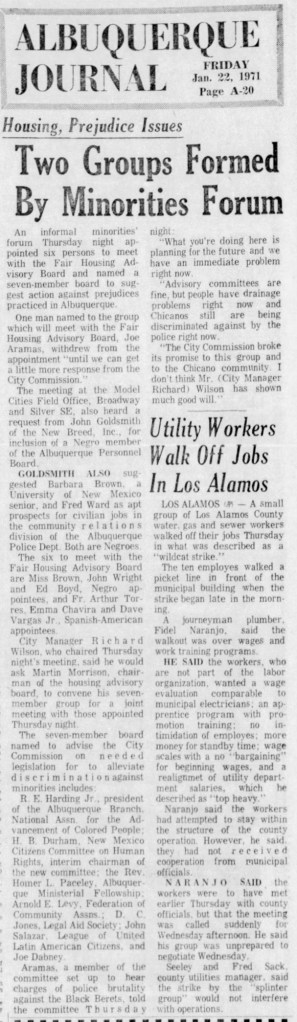
In addition to the contemporary 1971 usage of the now racist “Negro” as accepted term, we still see usage of “Spanish-American” here in supposedly triculturally tranquil Albuquerque into the 1970s. And we also see that there’s a need for “Spanish-Americans” to serve as members on a committee going to the Fair Housing Advisory Board to “suggest action against prejudices practiced in Albuquerque.”
As in the Advisory Board’s actions weren’t already going far enough, eight years after passage of the City’s fair housing ordinance and three since the federal Fair Housing Act. What happened here and happens everywhere between passage of legislation, particularly civil rights law, is particularly interesting.
Yet we very much tend to gloss over what happens post-passage. Civics classes on down stick to the date something gets passed, has that date as a question on the chapter quiz, and leaves out all the “sausage making” that is the post-passage enforcement and norm-changing required to actually stop, or slow down, doing what led to the legislation getting passed in the first place.
We’ll keep looking into this relatively historical study gap, focusing on our city/area, as it is perhaps true that the study gap here is a bit wider than it is nationally. We’ll also roll around ideas on why that wider gap might exist, including contemplation on just why the Hell the Albuquerque Journal was still using “Spanish-American” as accepted term in 1971.
 Better Burque