Last time out, we started the story of Albuquerque’s multi-faceted pre and post-Statehood entrepreneur Joseph “Joe” Barnett with his 1900s ownership of the St. Elmo Saloon at 114 W. Railroad (now Central) Avenue. Today we walk, perhaps stumble a bit given the heady offerings, a few buildings west to 124 W. Railroad and the White Elephant Saloon.

Telling this part of Barnett’s story requires introduction of another fascinating character, George K. Neher. Like so many, Mr. Neher moved out here from points north and east, becoming a local tycoon in the same amusements (drinking, gambling, more drinking, theater, etc.) cultivated slightly later by Barnett. Prime among these was a place called the White Elephant Saloon.
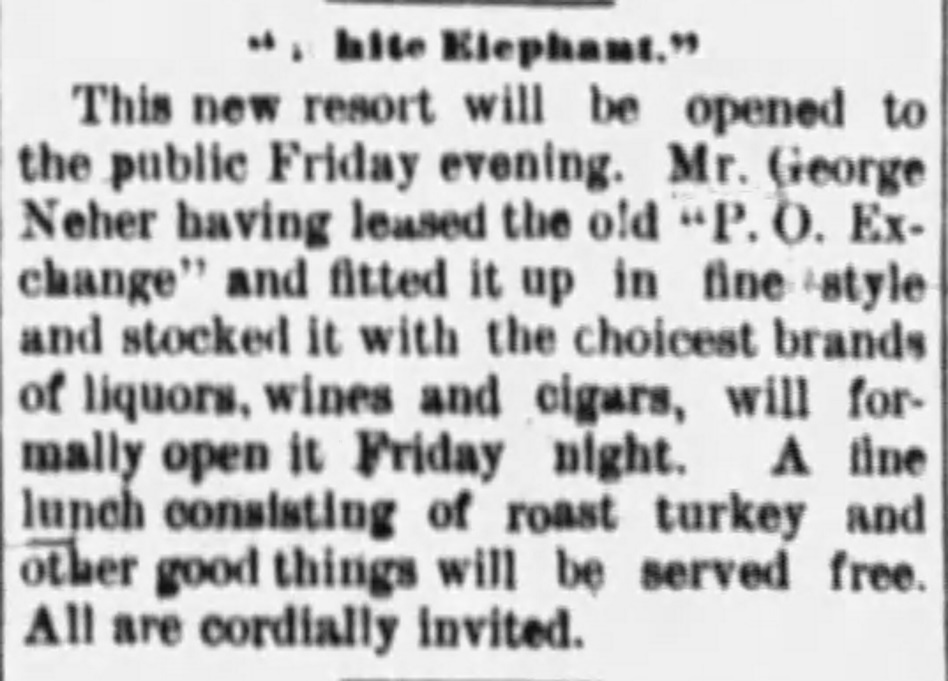
Establishing the Elephant gave Neher saloons at each end of Railroad Avenue, the Elephant east by the train depot in “New Town” and “George’s Corner” in “West Albuquerque” adjacent to the Territorial Fair Grounds immediately west of Old Town Plaza.

Neher went on to other holdings, the most temporarily famed being the “Neher Opera House” opening in 1900.


You might be getting a sense of cinematic deja vu reading Neher’s grand plans for grand opera in the hinterlands (i.e., ABQ), and the Neher Opera House story definitely resonates with “Fitzcarraldo” and other films (and it is fun to think of Klaus Kinski as George K. Neher). Neher’s grand plans didn’t include hauling an opera house over a literal mountain, but he did run into a metaphorical mountain of litigation concerning the folks he bought the property from at Third and Tijeras and how much that property was actually worth at time of sale. Eventually, the Opera House burned down the next year and the list of possible arson suspects apparently included just about everybody in town (you’ll probably need to greatly enlarge the story below, but it’s worth it).

Mired in the courts, Neher’s opera house was a pile of ashes for years thereafter. Meanwhile, the Elks’ Lodge opened its own “Opera House” in 1905, featuring varied events included this recital by local violinist Bruno Dieckmann.

Neher’s White Elephant continued to prosper throughout, rising in stature enough to be the only saloon featured in a rather amazing Territorial Fair/Statehood promotional insert in the October 13, 1902 Albuquerque Citizen.

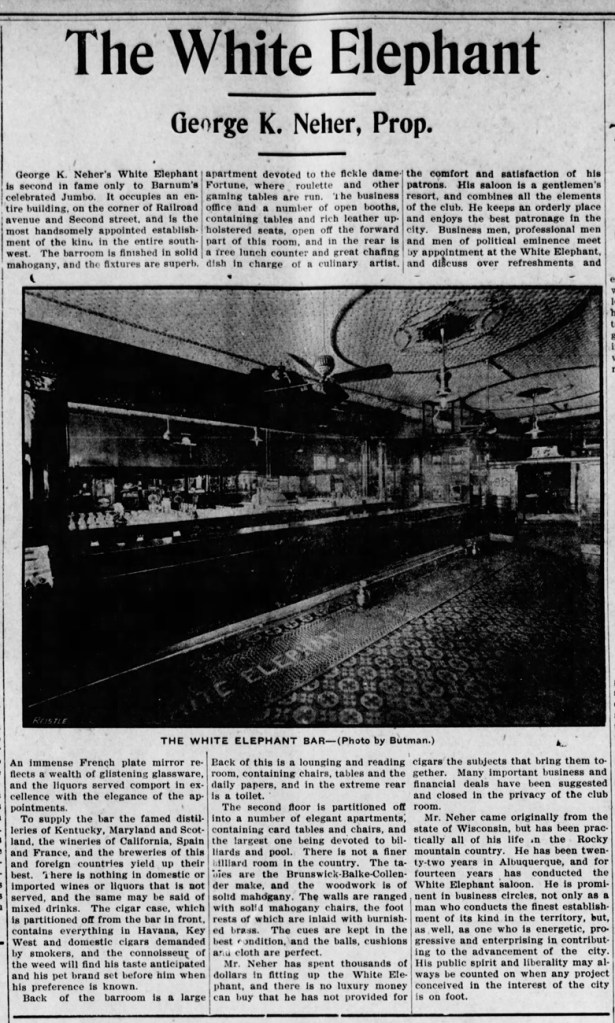
But as this series is about Joseph Barnett, you might be wondering…”where’s Joe?” Well, eventually Mr. Neher sold the White Elephant to Barnett, giving Joe, for a brief time, saloons at both 114 and 124 W. Central Ave. (Central having replaced Railroad as the name by this point).

Neher’s sale of the Elephant in 1909 was deemed so notable by the Journal that it printed this revised retelling of the story fourteen years later in 1923.

Also notable is that the 1923 retelling comes just prior to Barnett’s construction of the Sunshine Theater on the site of the old White Elephant. As for the saloon itself, it lasted for a while, but…

and many Barnett plans and bottles of beer eight years later…

That 1910-1918 time period between Barnett’s announcing eventual plans for W. Central and 2nd Ave. and closure of the saloon are significant for another entreprenurial reason, it was during this time Barnett’s “amusements” business evolved from drinking, gambling, more drinking, etc. to the newfangled movie business. More about that in our next installment.
P.S.: Because George K. Neher was such an interesting, newsworthy dude, it would be a shame to leave unmentioned some of his other exploits. To wit, he…
Made citizen arrests,

Bottled and sold water from somewhat nearby Coyote Springs (out closer to where the bombs and other secrets are stored ’round KAFB these days),

And helped provide a very needed resource for gamblers who desperate to wager huge sums not just on who would win an election, but by how many votes ($500 in 1902 dollars would be about $18,000 today).

By the way, whoever bet those five-hundred 1902 dollars on Rodey to beat Fergusson by at least 3,000 votes won big time. Bernand Shandon Rodey (“hey, isn’t that the name of a law firm here in town?”) beat Harvey Butler Fergusson (“hey, isn’t there a City Library branch named after Fergusson?”) by about 10,000 votes to remain Territorial Delegate to the U.S. Congress. If you get a chance to rummage through the Albuququerque Citizen stories of the time, you’ll notice the paper wasn’t just a big backer of Rodey, it tended to write up bits about how big the margin of Rodey’s victory was likely to be. Like several such references. You almost get the impression somebody at the Citizen placed that $500 bet on Rodey.
Nah…that would be unethical. Impossible.
 Better Burque