Note: Rummaging through WordPress yesterday, I learned that there’s been 1,041 Better Burque posts since 2016. Skipping past the pretty numbing thought of how much time your humble blogger has wasted frittered away invested writing all this stuff over the years, it also occurs to me that I’ve just about never reposted any of the 1,041.
As a innately lazy person, this realization is damn close to shocking. You mean I can just copy/paste something, stick a “Note” at the top, and voila! Well sign me up for some of that.
I also noticed yesterday in my rummaging that some old posts of the more “evergreen” variety continue to find readers today. Below is one such post. There’ll be more reposts in days to come, maybe not 1,041 of them, but a smattering that I’ll egocentrically label “Best of.”
Enjoy.
May 23, 2017
Not too long after getting my driver’s license in 1977, or maybe even a bit before, my father entrusted me with perhaps the single sexiest vehicle in automotive history. It looked almost identical to this:

The “wood-paneled station wagon” Vega was just one of a melange of not-so-great vehicles my dad rotated through, seemingly because he so much enjoyed having them break down and putting them on cinder blocks in the rural yard of my youth. I say “seemingly,” because his working on these cars atop the cinder blocks was always accompanied by his steady and unending stream of expletives.
My job was to hand him tools and listen to the swearing. In some ways, I think this “job” prepared me for my life as a middle school teacher.
Among these hulks was one absolute beaut, a ’67 or so black Lincoln Continental with “suicide doors,” looking something like this,
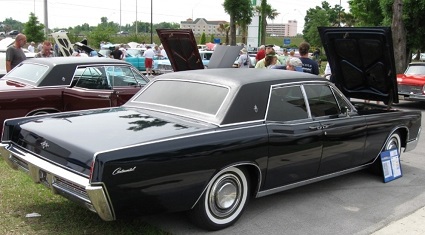
a vehicle we could only afford because the 1973 Oil Crisis had driven gas prices to unimaginable heights (about 50 cents a gallon) and everyone was dumping Lincolns and such.
I dwell on that black Lincoln because the other vehicles strewn throughout the yard were so awful. For some reason, my dad was in love with the aluminum chassis idea of the Chevy Vega, a love shared by probably only about ten people worldwide, none of whom were automotive engineers. This love was ultimately extended to me, unrequited, in the form of a “Cosworth Vega” as my high school graduation present. It looked something like this:
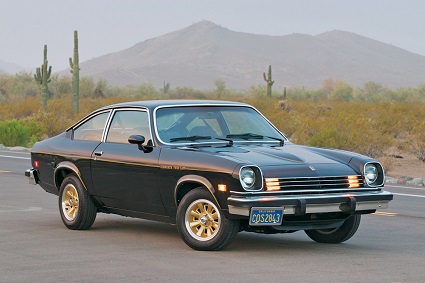
You might notice my dad’s love for black automobiles, a love enhanced by the fact that black vehicles were cheaper in the broiling heat of North Central Texas. “My” Cosworth Vega was black with black interior and an air-conditioner that might have worked enough for those living in Inuit country, but was nowhere near enough for DFW.
The other aspect of this particular Vega, the “Cosworth” also conveys my father’s long-time love for hot rods. Throughout my early childhood he raced 1/4-mile on semi and mostly-legal tracks in the area, specializing in sticking outrageously large engines in ridiculously small cars. For example, he put a Chevy 327 engine in a Triumph 3 looking something like this:
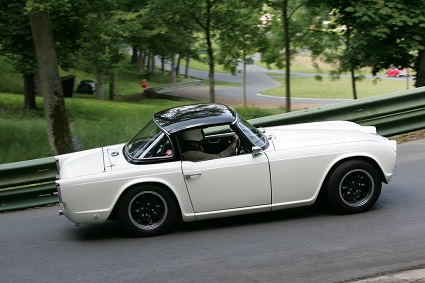
No, I am not making this up. A Chevy 327. He was kinda crazy, my father.
He did the same thing with other vehicular models, until he flipped over an El Camino racing 1/4-mile and Mom made him stop. His true specialty was sticking big engines in the back seats of Corvairs, a setup no amount of insulation and sound-proofing could overcome. Sitting in those Corvairs was deafening, even at idle. It was also a tad warm.
So the “Cosworth Vega” was named after some famous racer guy that I could not possibly care less about. Handing tools to my dad while hearing him nonstop cuss and having him flip El Caminos on the track sorta put a damper on any possible automotive love I might have had. I took the stupid Vega for graduation, sweated my ass off driving it for a Texas summer and got rid of it, how I don’t exactly recall, as fast as I could.
Anyway, getting back to that beautifully “wood-paneled” Vega, my most self-conscious teen year or so was spent driving this monstrosity around. To refresh the visual, let’s take another look at it:

And my dad wondered why I had trouble finding dates.
So one afternoon I’m driving this fine, fine automobile to a friend’s house, just after my dad has done some work on it atop the cinder blocks in the rural yard. Something about the carburetor and fuel lines needing fixing (I never paid attention to such details). The car runs fine over there to my friend’s place and all is well.
After doing whatever it is 16-year-olds did in 1977 for a bit, I get back in the car and start ‘er up. And it’s more like a Nova than a Vega, as in it “no goes.” It starts, but dies immediately. I hit the ignition again and that works, but the engine won’t start. Limited in my automotive know-how, I ponder all the many “solutions” I’ve seen my dad try over the years. I try one.
I pump the gas and try to start ‘er up again.
A few seconds later, flames appear in the cracks of the car hood, healthily growing at an alarming rate. Like any normal person, I immediately freak out and do nothing to help the situation. The flames continue to grow. I decided it best to vacate the vehicle and pop the hood as I do so.
The hood only goes up a bit, but the fresh air invigorates the flames even more. My friend comes out of his house and we pretty much do nothing but stand there for a few seconds watching the ugly yellow “wood-paneled” Vega’s engine burn and melt before we finally get around to using water, yelling and cursing to put out the flames. Actually, thinking back on it, I think the flames pretty much, eventually, went out on their own.
You’d be surprised how much plastic was in and around the engine on a 1974 Vega.
Amateur forensics later revealed that the cause was a fuel line that popped out of the carb, meaning I sprayed gasoline all over the engine while trying to start it up. Guess that little zip-tie musta slipped. As an aside, if I’d done this in the “Cosworth Vega” nothing would have probably happened, as it had those newfangled “fuel injectors.” I don’t know; I’m no automotive expert.
All of which is a long-winded explanation of many things, including why I have had a 2005 Honda Accord since brand-new, and have only opened the hood about three times in almost 13 years.
 Better Burque
You’re lucky the flames didn’t reach all that dry wood paneling 😉
LikeLiked by 1 person
My first ride was a 1963 Chevy Biscayne two-door, with an inline six and three on the tree. (I learned this lingo from people who actually knew stuff about cars, a group that did not include me. I knew bicycles, hoofing, and hitchhiking.)
Anyway, the Chevy and I are down in the San Luis Valley hanging out with evil companions one weekend back in 1974 and as I get set to return to Colorado Springs the drivetrain goes wonky on me. I can’t shift into reverse or first. Pleading and profanity are of no use. So I put it in second and hit the road, hoping the beast doesn’t explode en route.
I make it home to my shack off South Tejon and park on the street so I won’t have to use the reverse gear I no longer have and roust out a neighbor, who knows vehicles from stem to stern, inside and out, especially Chevys.
He pops the hood and has a peek, then slides underneath for another looksee, and grunts: “You lost a couple motor-mount bolts. Gimme your jack.”
Well sir, he jacks the engine up into its proper spot, replaces the bolts, drops the jack, and says, “Give ’er a go.” And lo and behold, the drivetrain is unkinked and I have first and reverse again. ¡Que milagro!
Alas, he wasn’t able to perform a similar miracle after I drove the Chevy into a Burlington Northern train. And I wasn’t able to drive for three years. The State of Colorado and America’s auto-insurance companies insisted upon it.
LikeLiked by 1 person
Love this story and am glad you’re train “visit” still left you able to write it years later.
LikeLike
Vegas never had aluminum chassis only aluminum engine blocks.
LikeLike
Thanks. It’s been almost 50 years since the incident in question, and I still don’t know the difference between an auto chassis and engine block. I’m good with that.
LikeLike
the 73 vega had many problems in engine..head gaskets were bad..it got hot a lot.in the summer..car was not engineered completely..a trial new motor was a disaster..it did not make the warranty or failed in 40k miles..gm did not do its.homework..like the corvair.it was a failure as a sar..experiment motor..flat six.motor..no research on it..
LikeLike