Just back from a month cycling, hiking, and living in Central Japan (Osaka, Onomichi, Hiroshima, Kyoto). Since getting back a few days ago, I’ve scoured the Internet for a video capturing my single favorite activity over a month of great fun: Riding a bicycle in Osaka.
I’d love to have shot my own little video showing what urban Osaka cycling is like, but I also love staying alive. And, at least for me, shooting video and staying alive wasn’t a workable combination. There are a number of reasons for this, the primary one being that cycling urban Osaka is C-R-A-Z-Y.
And I mean that in the absolute best way possible.
So instead of a personal vlog, I’m directing you to this video shot in a area of the city called Namba. I cycled through some but not nearly all of the city (it’s a big, big place), including Namba, and I’d say it’s about a 5 on the 1-10 “Osaka is C-R-A-Z-Y” scale, not the craziest, but with some zany and more than a dash of madcap. Screening the video, I’ve screengrabbed a few stills found through the half-hour running time and pass them along here with some observations combining what you see and what I personally experienced.
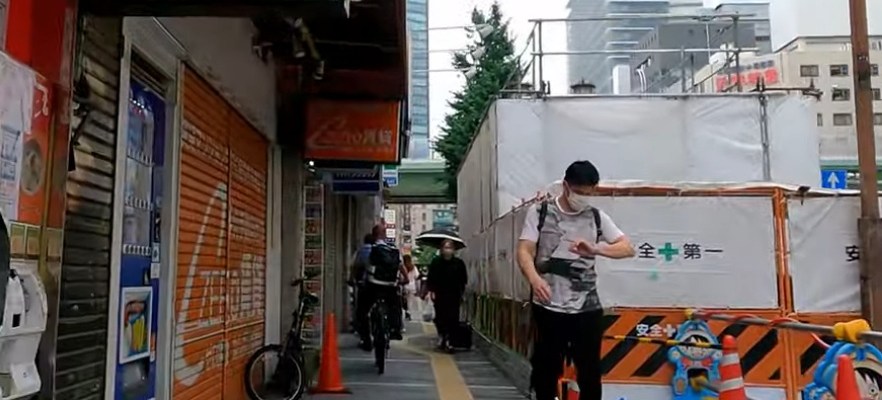
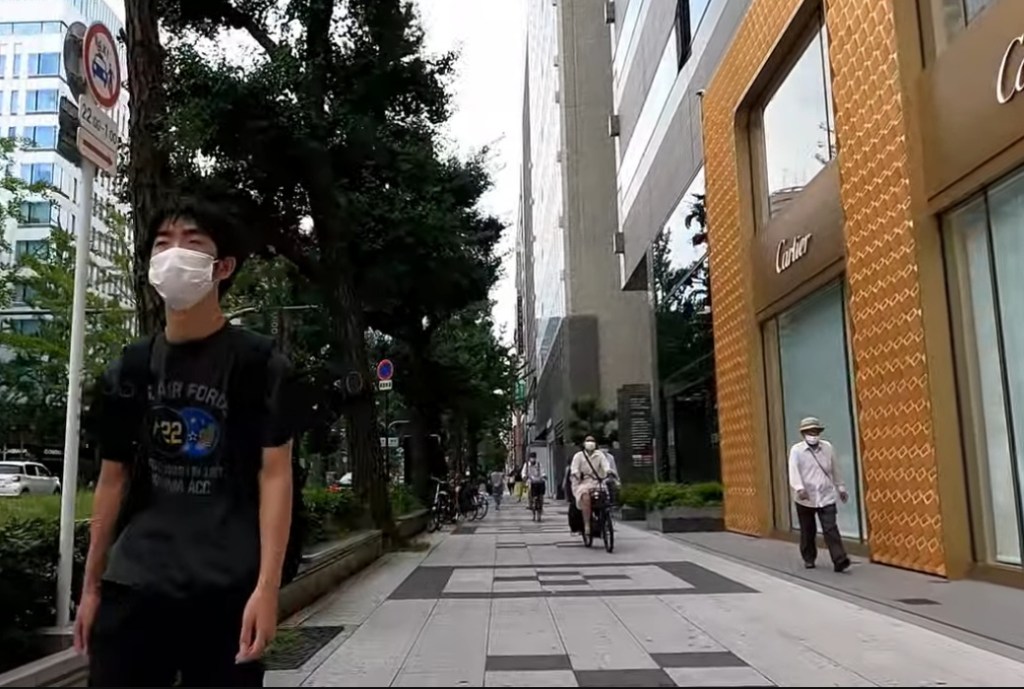
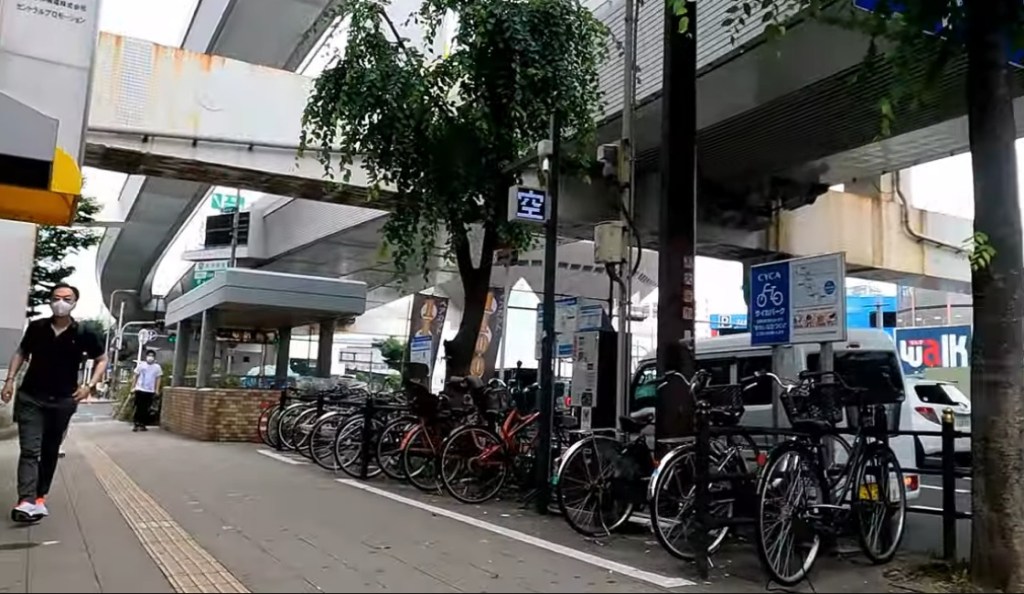
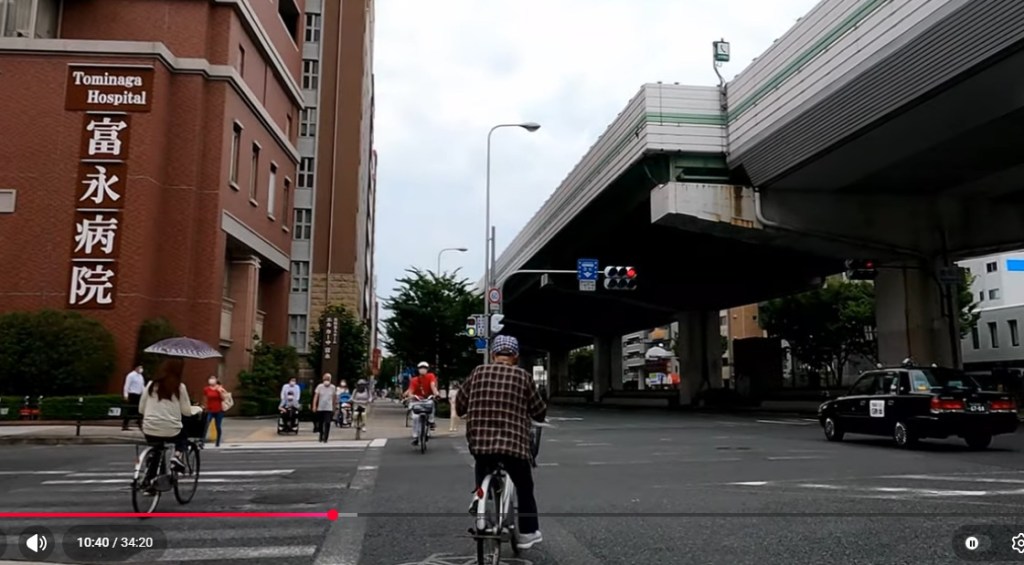
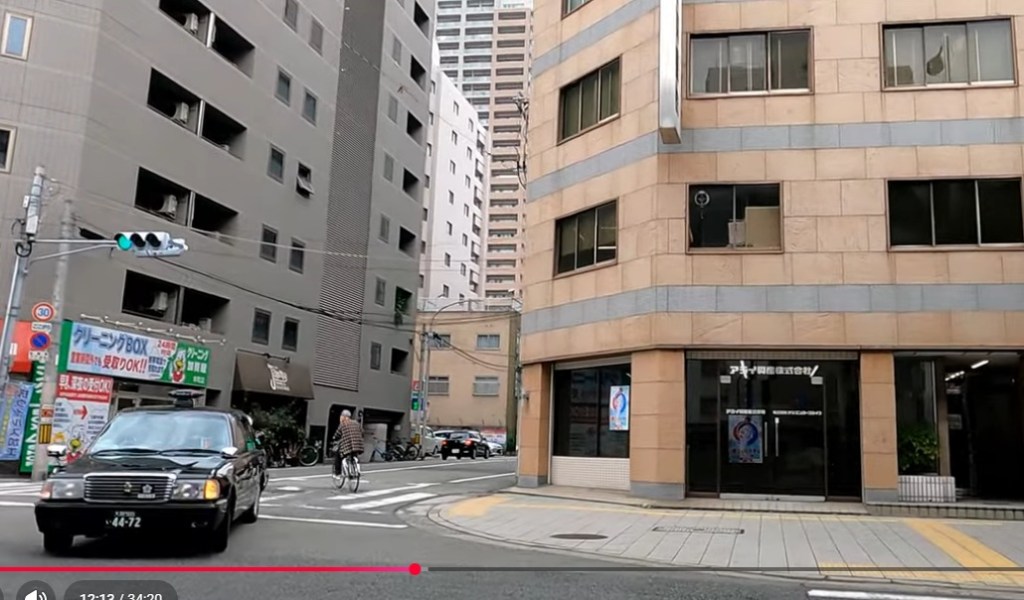
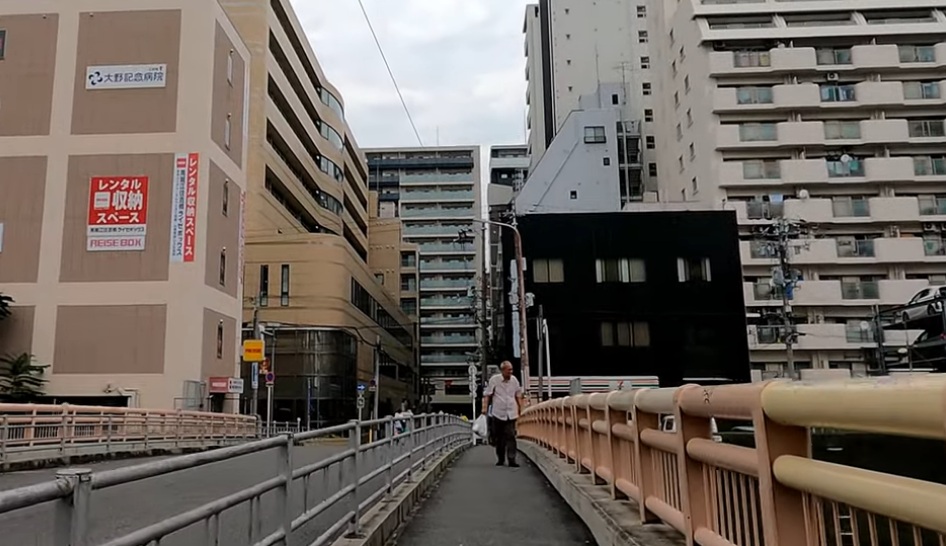
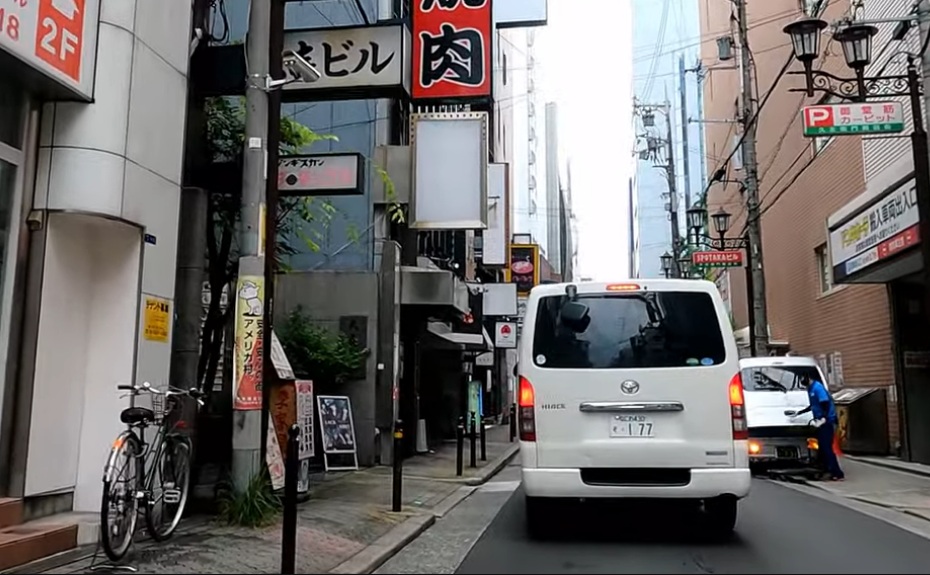
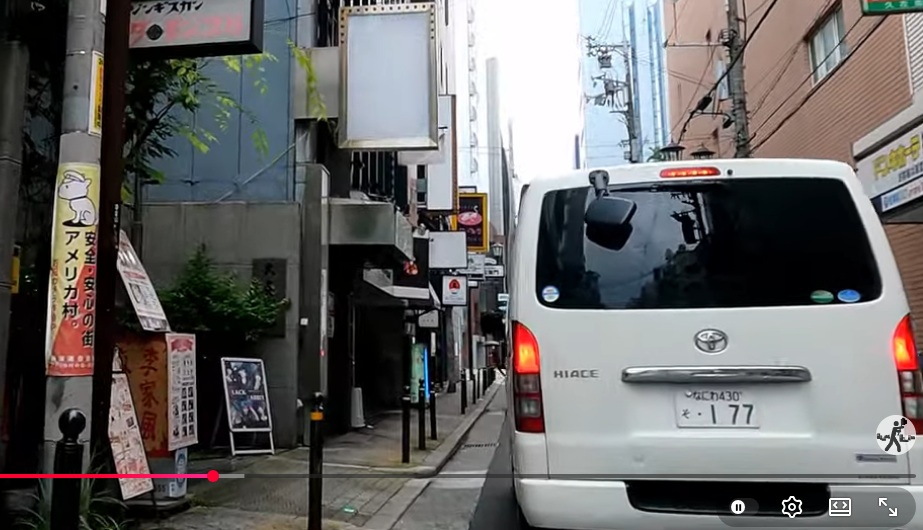
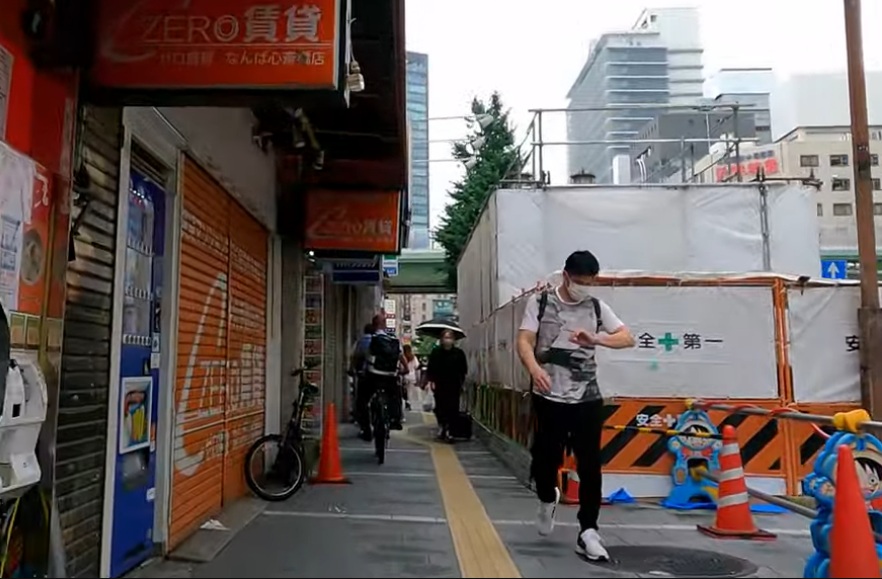
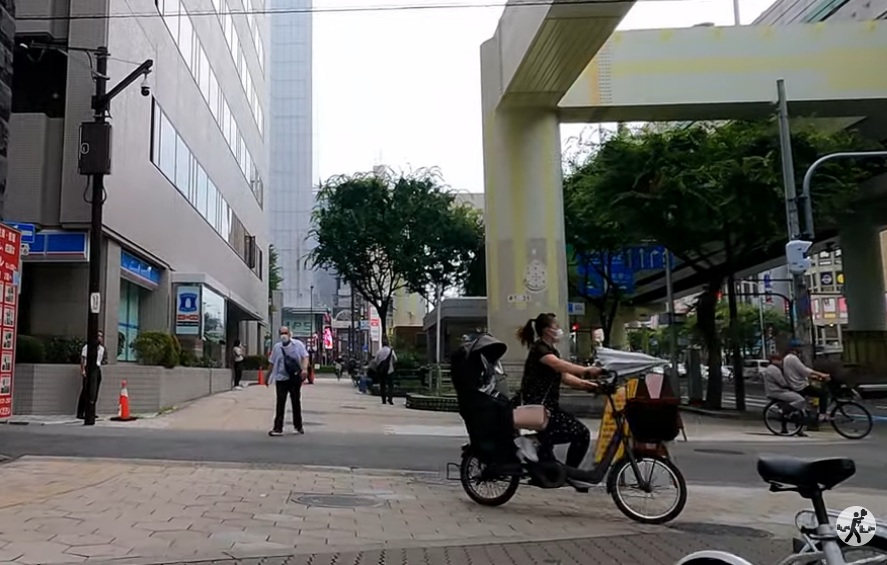
Okay, for starters, we have a very typical Osaka transportation viewing point. Lots of cyclists and walkers moving through each other on the sidewalk. This is the first what I’ll pompously call “paradigmatic” differences between transportation in Osaka/Japan and in the U.S.. Almost every cyclist rides the sidewalk, at least part of the time (as we’ll see further below). This first example is along a nice boulevard (heck, that’s a Cartier jewelry store on the right) with a really wide sidewalk. It’s wide enough here for all to easily swim their way through. Note also the two folks walking into the shot are using far different parts of the sidewalk to do so. This will be a trend.Here we have a somewhat narrower sidewalk that also introduces how Japan assists the visually impaired. See the yellow strip running through the middle of the sidewalk? That’s a continuous (until it’s not, as we’ll see later) raised “truncated dome” like we have at intersections (not always) here. This split of the sidewalk also serves as informal traffic divider. Japan being a “drive on the left” country, the very general but not nearly universal idea seems to be that folks walk away from this stillshot on the left and come toward it on the right. And you can also see that this very general “rule” is not being followed 100% here. In fact, I could be wrong about this idea being a community norm. Also, we see a bike parking section (I think that’s a subway entrance off toward the upper left of the frame). There are many bicycles in Japan. So many bicycles. Also, remember that each of these stills is actually from a video taken by somebody while they are riding a bicycle. They’re moving. So, fellow cylists, what would you do presented with the situation of obstacles and opportunities we see here? Answering that question, literally thousands and actually perhaps millions of time in a half-day of cycling Osaka is why it’s so damn fun.Now we’re at a crosswalk and the light has just given us the green “walk” indication that is REALLY hard to spot given all the visual stimulation. It’s just to the left and slightly above the cyclist in the checked top’s hat. So folks are starting across this fairly broad street, and they include: four cyclists, one either riding while holding an umbrella or with a device on the bike that holds the umbrella for them (the ratio of human-held versus device-held umbrella riders seemed about 75-25 human-held); at least one person and assistant using a wheelchair, another group of two behind doing the same (or maybe that’s a person pushing a cart or something, it’s hard to tell with my eyesight), and at least one pedestrian not using a wheelchair. Note where each person crossing is along the horizontal plane of the crosswalk striping. Namely, note that there doesn’t seem to be any discernible rhyme or reason whatsoever for the placement and directional choices of the users, regardless of means of conveyance. Isn’t this GREAT!Now we’re along a street that has a sidewalk, but that sidewalk is disappearing as that building ahead extends right up to the pavement. So the cyclist ahead is simply transitioning from sidewalk rider to street rider while also “riding against the light” (see the green light?). To our left we have one of Osaka’s approximate 47 gazillion taxis. Driving a taxi in Osaka has gotta be one of the most amazingly fun/stressful jobs anywhere. In my ten days there, I saw way beyond counting such scenes and did not personally witness any collisions between taxi and cyclist/walker. Jumping ahead, I didn’t see any collisions between road/sidewalk users of any kind. And that’s with an “N” of roughly fifty buttloads of roadways users and countless potential collisions.Here we are crossing one of Osaka’s many rivers/canals. At this one we have “true physical separation” as the transpo nerds call it, with this double-sided railing helping prevent us from being hit by a roadway user or cycling ourselves into the river/canal. It’s kinda narrow, the railings are at a perfect run-into-your-handlebars level, and this walker is holding that bag away from their body in a way that would seem to make passing impossible. Newbie/tourists like me would, and I often did, just stop the bike and walk/stumble their way around/through the walker (while also possibly whacking their handlebars/hands on the railing). Osaka cycling locals don’t stop. For almost anything and any situation. They just keep riding until the guy with the bag scrunches up enough to enable clear passage. It’s amazing to behold.This is a two-parter. First we see the cyclist/videographer riding on the narrow street (maybe it’s one-way, maybe it’s not, how can you tell? Let me know if you find out. Actually there are signs, but when you’re cycling in such an enviroment you never have eyetime enough to find out.) The white van has just stopped at a red light ahead, as have several drivers in vehicles beyond the white van. We have a delivery driver unloading things to the right of the van fully blocking that option, and there’s a bollard-filled narrow slanted sidewalk to the left with bikes, sandwich boards and who knows what else sticking out, making things even more narrow. So what are you gonna do, Osaka cyclist person (having read this far, you are now unofficially deemed an “Osaka Cyclist Person”)? Okay, time’s up. We’ve caught up with the white van. So is it gonna be wait at the light, or ride that sidewalk? I think you know the answer. Skittering between street and sidewalk cycling in Japan is an art form. I only got to paint-by-numbers, Level 1, in my month there. I saw plenty of Matisse’s, Hockney’s, and Rembrandt’s. Their ability to seemlessly move, never stopping, between sidewalk and street should be captured in a museum.Building on what’s been shown/discussed above, we have the disability stripe, various road user types, assorted obstacles, and the umbrella, all scrunched into a smaller canvas. To top things off, I think the walker coming toward us mid-frame has rolling luggage, another near-ubiquitous element of Osaka transportation. So many tourists, especially with the Yen so cheap, about 157 to the USD. As something of a blogpost final exam, I’ll ask you the cycling student: “What are you gonna do here?” And no, “stopping and walking my bike” is not an accepted answer. The first obstacle, “person walking toward us while looking at watch” is easy, but are you gonna wait out the slower cyclist ahead much beyond the rolling luggage person? What about that umbrella? And what about obstacles you can’t see yet? Remember students, show your work.And I’ve held out to the last before getting to one of Japan’s famed, “Mama-chari.” Famed to the point of having the Japanese Government devote a webpage to them. In English, “Mom bike,” Osaka and Japan have what is likely millions of women riding low-slung, step-through bikes, often electric, festooned with baskets and/or child seats in the front, definitely a child seat in the back (most often covered as seen here and/or fully waterproofed with various devices including little baby ponchoes that are so damn cute). I certainly can’t count high enough to tell you how many mothers and kids I saw on such bikes over my month in Japan. Mama-charis are also known for their riding style, which is delightfully “Fuck you, I’m riding a really heavy bike with my kids and I will run your ass over in my cargo bike/kid/ebike heaviness without even thinking about it, so get the fuck out of my way because I have to get this kids to day care/school/get groceries/shop for shit/whatever.” The mama-chari seen above is riding in this typically aggressive style, while also holding, it certainly appears, an umbrella in her right hand in case it starts raining, and strapped with a large pink purse that just really ties the whole Mama-chari room together. These women are, and I am not kidding, my new heroes. I am in fucking awe of these people.
So there you have a brief look at urban cycling in Osaka. Check out the video for a far better insight into the experience. A few bullet-point final thoughs:
Yeah, nobody riding a bike is wearing a helmet. I’d guesstimate the percentage of helmet wearing at 5%. That’s probably too high, but I’m factoring in tourist/newbies like me.
Riding on the sidewalk is “conditionally” legal in Japan, with the word “conditional” doing some Andre the Giant in “The Princess Bride” type lifting in that description. There are a bunch of rules and “conditions,” but I certainly didn’t see any enforcement of such rules and I damn sure didn’t see any following of them.
I’d strongly guess the reason I didn’t see any collisions in my roughly 30 hours of urban riding is that everyone is going slowly. Nobody is in lycra on road bikes training for the Tour de France. Actually, there are a very scattered few recreational/training riders, but they only ride the road, and there are so very few of them they’re pretty much extraneous to the tranpo mileu. Folks are just using bicycles to get where they need to go, and there’s a much, much larger number of such folks than we have here in the United States. Cycling is part of daily life in Japan, and until it is here in the States, the lycra crowd, albeit very small relative to overall roadway users, will far outnumber the “mama-chari.”
Speaking of few, there are some actual, painted “bike lanes” on busier “stroads” (no physical separation) and places like Kyoto have painted bike “lines” and related stencil to show that cyclists are permitted to ride contra on one-way streets, etc. I kinda doubt any locals really ever consider such signage in their routing or decision-making. One gets the impression such infrastructure is done primarily to make a set of transportation bureaucrats and/or insurance folks happy.